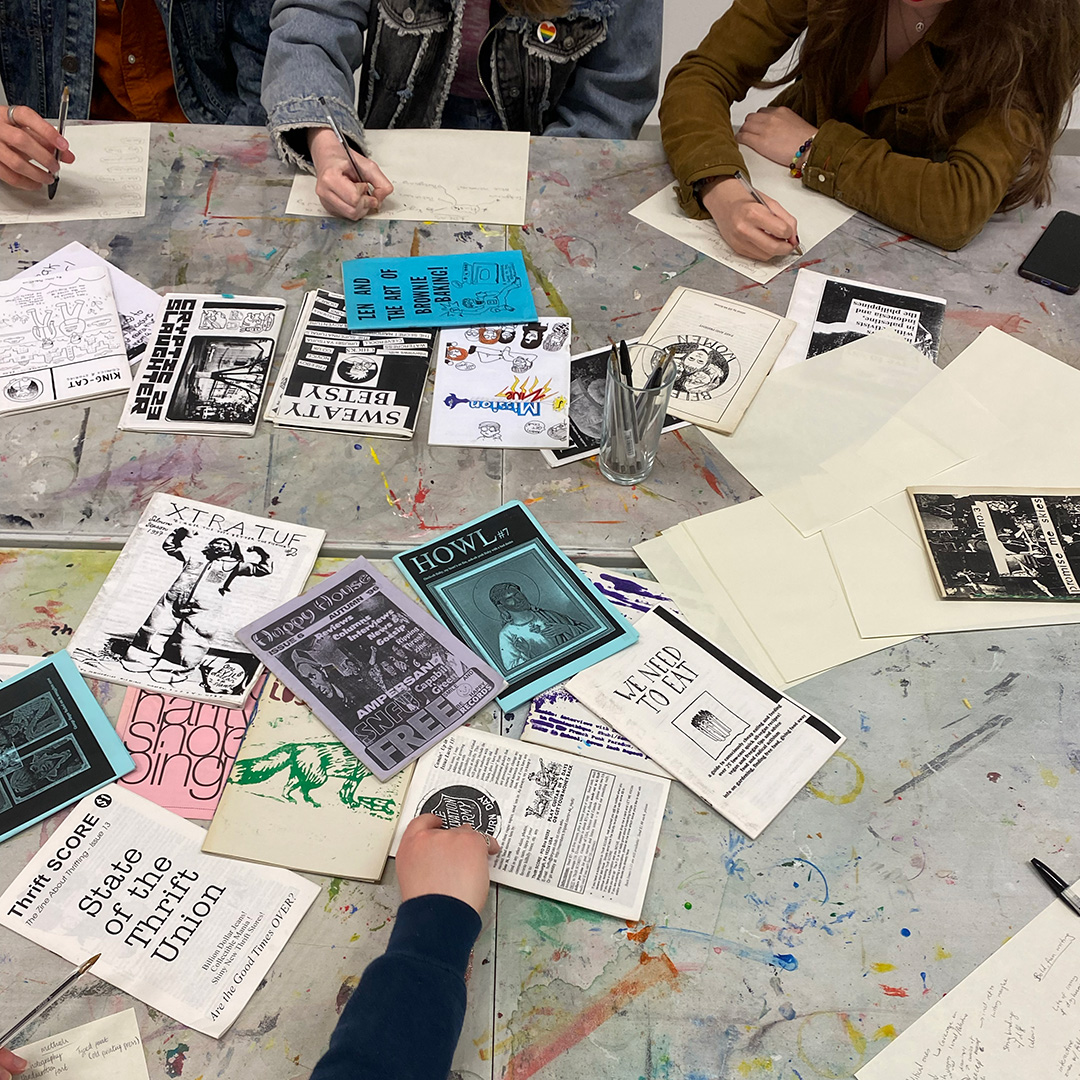
Ways of Working, a research visit as part of British Art Network Research Bursaries

In February 2026, Void’s Curator of Civic Engagement, Cecelia Graham, travelled to Wales to undertake research as part of British Art Network’s 2025/2026 Bursary Awards. During her time in Wales, Cecelia met with three organisations across the North and South of the region who are exploring means of learning from local communities, and ways of supporting them to reconnect with their local environments, food systems, craft practices and place-specific knowledge. This included Conveyor / Cyfleuwr, Peak Cymru and Field Work Studio. 


~~~~


Slow Travel

  • A Translink bus from Belfast to Dublin Dock
  • A Stenaline ferry from Dublin Dock to Holyhead

The research trip started on a frosty February morning at the Dublin Docks where I was catching a ferry to Holyhead in the north of Wales. I have found that, more often than not, slow travel has become an important part of transport planning, whether in my role at Void or in independent projects. After a busy few working weeks, I’m grateful for the opportunity to both mentally and physically slow down as I take a seat on the deck outside and contemplate the waves lapping choppily at the side of the boat. Slow travel, and the privilege to do so, permeates my week unexpectedly as trains and buses become a site for reflection after each visit.

The ferry docked at Holyhead and I took a train to Colwyn Bay to visit David Cleary, a curator who founded the initiative Conveyor / Cyfleuwr Cymru. I had joined David for a ‘dreaming day’ in 2023 where we discussed our respective desires to start organisations and what they might look like. I was delighted, therefore, to meet David now that Conveyor has been launched. Conveyor is a nomadic arts initiative and curatorial platform based in north Wales, producing collaborative public programmes which connect with people and places. It derives its name from a thing which communicates or transfers energy.


Conveyor Cymru

  • A train from Holyhead to Colwyn Bay 
  • A car from Colwyn Bay to Llandudno, and then to Conwy

During my time with David, we travelled across different areas of north Wales with Colwyn Bay as our base – I noted David’s curiosity and deep knowledge of the area as walking shaped our time together, and roaming became a vehicle for sharing experiences working in civic roles. I learnt about David’s social practice during walks in Llandudno and Conwy, and we discussed the particular challenges and joys that this form of working brings. We spoke about civic engagement roles within institutions, and how they are often utilised as an institution’s way of making connections within a neighbourhood – whereas a civic engaged organisation, alternatively, makes an effort as a whole to connect outwards.

Amongst our discussions about projects that David is working on, we chat about civic sites and the importance of working outside of (physical) organisational walls. We talk about the potential of working in libraries, and the importance of having a visible space in the city where informal connections can be made. Conversation turned to the expectation for socially engaged projects to take place in and work with  ‘unexpected’ or underused sites, and how this has a tendency to shape projects without consideration about why a specific place might not feel safe for the public to gather, for example a lack of accessible routes. 

Within my practice, I think – evidently – a lot about travel. This feels particularily relevant within my role at Void Art Centre, where travelling on a 1.5 hour bus bookends each day. I was curious to learn whether David’s newly acquired driving license has impacted or opened up his work – specifically due to the rural locations and practitioners with which he engages. Whilst travelling freely, not depending on a precarious transport infrastructure, has brought about an ease of movement, David tells me that public transport still shapes where his projects take place, especially if they happen in the evening. David’s knowledge and commitment to access underpins a lot of our conversations, and enables me to think of how we could work here at Void. Although we are based in Derry’s city centre, we are situated in and engage with a wider county and council area affected by a lacking collective transport provision ~ how can we make sure our work, if taking place off-site, feels accommodating to those without access to a car? 


Peak

  • A train from Colwyn Bay to Abergavenny via a stop at Crewe

After saying goodbye to David, I took the train from north Wales and travelled south to Abergavenny to visit Peak Cymru, an arts organisation based in the Black Mountains. I have been familiar with Peak’s approach since implementing socially engaged practice within my work. Peak works with young people, artists and intergenerational communities to respond to the rural context in which they work and the socio-ecological issues of our time. Through young people’s programmes, residencies, commissions and cross-sector partnerships, Peak aims to create long-term, place-based change.

I wanted to visit Peak to learn more about their Pegwyn programme, which brings artists and young people together to think about language futures for Wales, their work with young people and their commitment to working with artists in rural sites. As soon as I meet Melissa and Louise from Peak, I’m reminded of the possibility of arts organisations to exist without a gallery or exhibition programme – instead, Peak’s programme celebrates the multiple possibilities of artistic practice, from residencies to commissions in public sites such as the Abergavenny train station. Someone once told me that the gallery can be ‘the least interesting part’ of an arts organisation, and I think about this often as I talk to the Peak team whose programme feels unique and authentic to where they’re situated. 

We meet at the train station, stop off at the Angel bakery and take a walk in a nearby park before taking a seat at a public picnic table to chat further. We discuss funding models, Peak’s governance and co-director model, and the various definitions of socially engaged practice. From our conversations, it’s clear that Peak’s internal and external workings reflect one another. Within their programme, they are experimental, and open to testing alongside their local context – their very structure, and thoughtful approach to often ‘invisible’, internal processes reflects this.

Peak’s programme embeds long-term working with projects such as Our Plot (transforming an old playground into a community garden alongside young people and local residents); The Living Usk (bringing young people, ecologists, farmers, scientists and community members together to explore the future of the River Usk); and Peak Peers (a creative programme for people aged 18-30 rooted in the rural landscape of Wales). We speak about the programmes, the consistency needed from an organisation and the inner workings of procuring funding for long-term, multi-annual projects. Similarly minded projects at Void are funded using piecemeal budgets, and this conversation enables me to open my mind to other funding avenues available to us.


Field Work Studio

  • A train from Abergavenny to Bridgend
  • A car from Bridgend to Slade Farm

Field Work Studio is run by Phoebe Davies, an artist whose work I have been familiar with since joining a brilliant WhatsApp group they created which practitioners across the UK use for sharing opportunities. Alongside hosting a residency, Field Work Studio also provides support for artists in the form of fundraising support, strategies for building long-term career development, and arts partnership and touring consultancy. I was interested in visiting Phoebe for various reasons – her argro-ecology working method, cross-sector residency on a farm, and expanding knowledge of what socially engaged work can be. Learning about the multidimensional aspect of lending a hand on a family farm during lambing whilst running a residency alongside independent practice enabled me to deepen my understanding of how socially engaged work must echo the rhythms of those sectors we wish to engage with.

The first stop on the visit was to a local potter and secondly, to a local beach. It struck me that there was something consistent across everyone I met – we didn’t just sit in a space or a coffee shop to chat – we walked together, scrambled over rocks on beaches, sat on picnic benches, visited local businesses and craftspeople, spent time by water, and toured civic spaces. At Void, we often host visitors, giving them tours of the city and introducing them to our networks. It’s not lost on me that we are all so similarly minded. Context is deeply embedded within our work.

Making our way to Field Work, which is housed in Slade Farm, we stopped to look at an orchid planted by Phoebe’s mum on the banks of the entrance. The residency is based on a three-generation family tenant farm in the Glenmorgan heritage coast, and the programme spans community growing, rural residencies and research alongside artist support. The initiative learns from its surroundings and labour associated with organic farming and rural culture with a key part of its aims to ‘broaden knowledge and raise awareness of arts, rural ecology, farming, biodiversity and the environment.’ At this point in the research, it feels apparent that there is a common thread connecting us – Fieldwork Studio, Peak Cymru, Conveyor, Void and my independent practice too. Finding commonalities with other disciplines and ways of working feels integral to socially engaged work, opening space to experiment and relate, and to find opportunities to engage with the multiple crises we’re experiencing. Art practice can enable us to speculate on or build a better future, whilst working with different sectors enables us to think about organising differently, encouraging empathy and interconnectedness. 

We have tea at Phoebe’s house, whilst finding out more about Fieldwork Studio’s ‘Working with Time’ strategy which aims to create sustainable and generative production strategies. Whilst my research is predominantly looking at socially engaged work, these strategies feel particularly useful for Void’s internal working and exhibition programme which questions posed such as ‘As a producer how do we look after our crews?’ and ‘Where do we choose to put our energy?’. We also discuss Field Work’s Agri Culture Principles which echo the Void team’s ambition to move to a social permaculture working model. Field Notes brings together various methodologies for working, such as DIY and DIT (Do it Yourself / Do it Together) and Perma-Culture.


Slán / Hwyl

  • A train from Bridgend to Cardiff
  • A flight from Cardiff Airport to Belfast City 


I get a plane back to Ireland, and it’s not lost on me that whilst the week started slowly, it’s ending with acceleration. I need to make it back to work so I can invigilate on the weekend. These research trips are important, giving space outside of a stretched arts sector to learn and share with one another, however the busy precarity of working in the north of Ireland means that researching even within our own context feels like a rare opportunity. 

I’m excited to build on learnings from the past week – from Conveyor’s social practice and library working, to Peak’s commitment to working with young people and transparency, to Field Work’s agri-culture strategies. I am thankful for the generosity of each of those I spent time with, and their openness sharing working methods, challenges and dreams for the future.


This project has been funded by British Art Network Research Residencies 2025-2026.

front view of the Void Gallery

Void Art Centre welcomes two new team members!

In 2024, Void Art Centre will commence a living practice of socio-permaculture. The concept of social permaculture is the application of permaculture principles to human relationships, communities, social systems and organisational models. Social permaculture is about connection between people, economies, and governing structures – creating the conditions for humans to flourish on a societal level, thus to develop beneficial relationships with the ecosystems which sustain us.

In order to do this, we’ve hired two new fantastic team members to help us on our journey. We’d like to extend a warm welcome to our new Head Of Sustainable Growth, Mitch Conlon and our new Curator of Civic Engagement, Mhairi Sutherland. We’re incredibly excited to have them as part of the team here at Void Art Centre.

With both of them having a wealth of experience in working in the arts across Ireland and further afield, they bring so much talent, knowledge and expertise to the team and we are delighted to see what the future holds for Void.


Mitch Conlon

Mitch Conlon is an artist and organiser who has worked across the creative sector and visual arts here in the North for over ten years. Having lived in a number of cities across the island Mitch is deeply passionate about living and working in Northern Ireland and specifically artists’ role as active citizens within our society. He has continuously prioritised working collectively, collaborating with others as a rewarding and fulfilling choice that runs contradictorily to the recommended path, that of individualism and competition within our creative sector. Sharing and learning with like-minded, empathetic organisations such as FRUIT SHOP, PS2, Array Collective, COLLECTED, Catalyst Arts and Knee-jerk, Mitch has chosen to work in peripheral locations within DIY structures and self-organised groups. This eco-system of experimental and community-led infrastructure is critically undervalued in the North and is the seabed from which our larger civic institutions are dependent. It is this similarly minded network in Derry that he will seek to establish the foundations from which a sustainable organisation and programme can flourish.


Mhairi Sutherland

Mhairi Sutherland is a visual artist working in photography, video, and drawing, awarded a PhD in 2012 from the Dublin Institute of Technology (DIT) and  an MFA (Distinction) from the University of Ulster, Belfast (1994-96). An experienced freelance facilitator, mentor and coach in digital storytelling, photography and the visual arts, Mhairi has recently facilitated a CAWT programme (2022) with rural and other groups through the Verbal Arts Centre, and was Creative Producer as part of the Third Space team, a cross-border PEACE IV programme, delivering a digital storytelling programme to 600 young people across NI and border areas. (2017-21) Previous facilitation clients have included Void Gallery Engage programme, Prison Arts Foundation (PAF), Community Foundation NI, Regional Cultural Centre Letterkenny, The Ark, A Cultural Centre for Children Dublin and the Moville and District Family Resource Centre.

Public projects include a commission from the Hasselblad Foundation and Valand Academy, Sweden, for Drone Vision: Warfare, Surveillance and Protest, a group triptych exhibition shown in Gothenburg, Lahore and Nicosia in May 2018, The Dome, a site-specific research project, supported by a SIAP Award from the Arts Council of Northern Ireland and PRONTO,  commissioned by 1418NOW and Golden Thread Gallery, Belfast, as part of the ‘Radio Relay’ cultural programme for Northern Ireland, 2016. Her work has been exhibited in one person exhibitions in the Leitrim Sculpture Centre, Manorhamilton (After the Blacksmith, 2018) Regional Cultural Centre, Letterkenny (Arc of Fire, 2011) OMAC, Belfast (Fig: YS, 2008) Context Gallery, Derry (Fathom, 2002) and Street Level Photoworks, Glasgow (Blackout, 1999), numerous group exhibitions and is represented in private and public collections in the UK and Europe. Mhairi  has been involved with collaborative and site-specific projects beginning with the Sitework Public Art team, Orchard Gallery, Derry (1988-89), a founding member of artists’ group Not in Kansas, Glasgow (1998-2003) and is currently a member of LOCI (2014-) a group of women artists, researchers and writers.

Acknowledgements

Photographer: Sara Leahy


Void Gallery is supported using public funding from Arts Council Northern Ireland, Arts Council National Lottery Fund, All Island Fund, Austin and Hope Pilkington Foundation, Arnold Clarke Foundation, Bank of Ireland Begin Together Arts Fund, Community Foundation Ireland, Derry City and Strabane District Council, Enkalon Foundation, National Lottery Community Fund, The Ireland Funds, Foundation Foundation.


Job Vacancies – Void Art Centre are hiring

In 2024, Void Art Centre will commence a living practice of socio-permaculture. The concept of social permaculture is the application of permaculture principles to human relationships, communities, social systems and organisational models. Social permaculture is about connection between people, economies, and governing structures – creating the conditions for humans to flourish on a societal level, thus to develop beneficial relationships with the ecosystems which sustain us.

Void’s organisational structure will be based on co-existence and co-creation as well as sustainable use of local resources (both monetary and non-monetary) such as public grants, voluntary commitments, mutual aid, commercial arrangement, and private sponsorship. By taking this view of our financial well-being, we aim to enrich and negotiate our model in relation to an increasingly financialized world. In an era when making sense of our place in the world has to be an act of imagination, art is a necessity of life. The role of Void is to act as a local lifeline.


HEAD OF SUSTAINABLE GROWTH

Salary: £ 25,006 per annum

Location: Void Art Centre, 10 Waterloo Place, Derry. (Some remote working may be possible)

Working hours: 30 hours per week

Contract type: Part-time (3 months probationary period)


Reports to: The Director & Board of Trustees


Essential criteria: Candidate must have a minimum of 2 years fundraising experience and a third level finance qualification or equivalent professional qualification. 

Desirable criteria:  experience with Sage accounts and day to day bookkeeping for an organisation. Experience of devising and delivering successful fundraising (over £50k) in an arts, culture or not for profit settings


JOB DESCRIPTION

Overview:

This is a fundraising and financial management role based on permaculture principles. We are  interested in exploring how our organisation, through its financial structure and income generation strategy, can become more eco-sustainable.


The Head of Sustainable Growth is a new socio-permaculture driven role at the heart of Void Art Centre’s financial and strategic development. Void Art Centre is looking for a highly organised and motivated person with experience in fundraising and financial management who is interested in testing out this new approach. In this role, the candidate will oversee operations in Void Art Centre in order to support the institution’s viability, and actively stimulate its healthy enrichment to facilitate the smooth running of the institution’s activities in cooperation with the rest of the team and in collaboration with the city of Derry.


Working closely with the Void team, the Head of Sustainable Growth will play a crucial role in developing and delivering Void’s future Strategic Plan 2024–28. The candidate will lead on the redevelopment and maintenance of Void’s partnerships, its financial management, income generation and fundraising in ways that embody their collective values of socio-permaculture.


This is a key role within the organisation reporting to the Director and the Board of Trustees. The Head of Sustainable Growth will provide specialist skills in accounts, payroll, financial reporting and fundraising.


Key Objectives:

  • Taking care of the institution’s sustainable growth. This includes budgeting, bookkeeping, financing and managing the expectations, needs, and mutual responsibilities of different actors and stakeholders (non-monetary);
  • Create new collaborative and in-kind solutions to achieve a sustainable environment both for Void Art Centre and the community it serves. 
  • Design strategies and practices of enriching the local exchanges and collaborations
  • Develop funding sources to support the growth of the organisation as well as the public programmes.   


JOB SPECIFICATION

  • To perform and assist with fundraising and to provide data and budgets for fundraising projects.
  • Assisting the Director and other staff as necessary to prepare financial information required for funding applications to local authority and other funding bodies.
  • Working with the Director and relevant staff to evolve Void Art Centre’s socio-permaculture approach & contributing to the thinking of new, relevant areas for artistic research and investigation 
  • Completing financial monitoring reports and ongoing funding claims as required.
  • Producing regular financial monitoring reports for meetings.
  • Working with relevant staff to consider how public programme activities can be strategically utilised for development purposes.
  • Supporting the development of programmes and co-commissioning partners for the public programme, where there are opportunities for in-kind or matched support.
  • Ensuring that Void Art Centre carries out its commitments with funders, co-commissioners, and partners, including reporting and appropriate acknowledgements across all printed and online platforms.
  • Developing earned income streams.
  • Overseeing the management of funding databases.
  • Attending local authority meetings and community forums with a view to strategic development.
  • Representing the organisation at in-house and external events with may involve public speaking.
  • Supporting the evaluation progress to reflect on impact, feeding these results into a continuous learning and improvement processes.
  • Carrying out all duties related to wages, salaries & employment matters including monthly returns and payments to HMRC, pension providers and banks.
  • Using software packages like Sage Accounts and Bright Pay payroll.
  • Carrying out all day-to-day bookkeeping, reporting and reconciliation tasks.
  • Documenting, overseeing and authorising the payment of suppliers.
  • Monitoring bank accounts and liaising with the bank.
  • Drafting accounts, preparing for audit and liaising with auditors.
  • Working in collaboration with the director to prepare budgets and forecasts.
  • Working on grant applications & supplying financial information for funders.


We appreciate this is an unusual role and encourage anyone who feels they have good financial management and fundraising experience to apply. 

Please send your CV and cover letter to hello@derryvoid.com


Acknowledgements


Void Gallery is supported using public funding from Arts Council Northern Ireland, Arts Council National Lottery Fund, All Island Fund, Austin and Hope Pilkington Foundation, Arnold Clarke Foundation, Bank of Ireland Begin Together Arts Fund, Community Foundation Ireland, Derry City and Strabane District Council, Enkalon Foundation, National Lottery Community Fund, The Ireland Funds, Ragdoll Foundation.


Series of colour and black and white logos