A talk by Leah Gordon, hosted by Artlink.
Artlink is researching the possibility of an Inishowen Art Festival. To support Artlink in this, curator Keith Whittle has created an inspiring programme of talks, mainly online, by some of the most renowned artists and curators working internationally to create art festivals celebrating unique places and voices.
As part of this programme, artist, curator and writer Leah Gordon will be giving a talk about the Ghetto Biennale, Haiti, originally conceived to expose social, racial, class and geographical immobility, on Tuesday 27 June, from 6-8pm. Leah will be presenting her talk via zoom but the call will be screened in Void Gallery, Derry. People are encouraged to attend the talk in person at Void to promote active discussion after Leah’s presentation, although joining online is also an option. Please state which in the eventbrite sign up form.
In December 2009, Atis Rezistans, the Sculptors of Grand Rue, hosted their first Ghetto Biennale. They invited fine artists, film-makers, academics, photographers, musicians, architects and writers to come to the Grand Rue area of Port-au-Prince, Haiti, to make or witness work that was made or happened in their neighbourhood. The Biennale aimed to be a “third space … an event or moment created through the collaboration between artists from radically different backgrounds”.
During this talk, Gordon will discuss one of the original strap lines of the first Ghetto Biennale: “What happens when first world art rubs up against third world art? Does it bleed?” The line is a transmutation of a quote from a book about the maquiladoras in Juárez, Mexico. The original quote, by Gloria Anzaldúa, states, “The U.S.- Mexican border es una herida abierta (is an open wound) where the Third World grates against the First and bleeds.” (Anzaldúa 1987, 3). She will explore what new practices, processes and relationships could emerge from these, often uncomfortable, entanglements.
The 2nd Biennale was held in December 2011. Yet while the Ghetto Biennale was conceived to expose social, racial, class and geographical immobility, it seemed to have upheld these class inertias within its structural core. In this presentation Gordon addresses the contradictions and challenges posed by the event, and how subsequent Ghetto Biennales sought to confront them.
Leah Gordon will also mention the current political crisis and insecurity in Haiti and how the Ghetto Biennale has responded to the situation. Gordon will conclude by reflecting how the Ghetto Biennale produces meaningful discussion about sameness and difference in an allegedly de-centred art world, and transcend different models of ghettoization?
Leah Gordon Biography
Leah Gordon (born Ellesmere Port, UK) is an artist, curator, and writer. Her work explores the ‘intervolved’ and intersectional histories of the Caribbean plantation system, the Trans-Atlantic Slave Trade, the Enclosure Acts and the creation of the British working-class. In the 1980s she wrote lyrics, sang, and played for a feminist folk punk band. Gordon’s film and photographic work has been exhibited internationally including the Museum of Contemporary Art, Sydney; the Dak’art Biennale; the National Portrait Gallery, UK and the Norton Museum of Art, Florida. She is the co-director of the Ghetto Biennale in Port-au-Prince, Haiti; was a curator for the Haitian Pavilion at the 54th Venice Biennale; was the co-curator of Kafou: Haiti, History & Art at Nottingham Contemporary, UK; and was the co-curator of PÒTOPRENS: The Urban Artists of Port-au-Prince at Pioneer Works, NYC in 2018 and MOCA, Miami in 2019. In 2015 Leah Gordon was the recipient of the Colección Patricia Phelps de Cisneros Travel Award for Central America and the Caribbean. In 2022, her award-winning feature-length documentary Kanaval: A People’s History of Haiti in Six Chapters was broadcast in selected cinemas and on BBC 4’s Arena. In 2022, Gordon also exhibited in and curated the Atis Rezistans | Ghetto Biennale exhibition at St Kunigundis Church at documenta fifteen, Kassel; her work showed at MOCA North, Miami; Power Plant Gallery, Duke University, NC, USA, and Haus der Kulturen der Welt, Berlin, Germany. In 2023 the Atis Rezistans | Ghetto Biennale exhibition at St Kunigundis Church at documenta fifteen was awarded ‘exhibition of the year’ by AICA Germany.
Acknowledgements
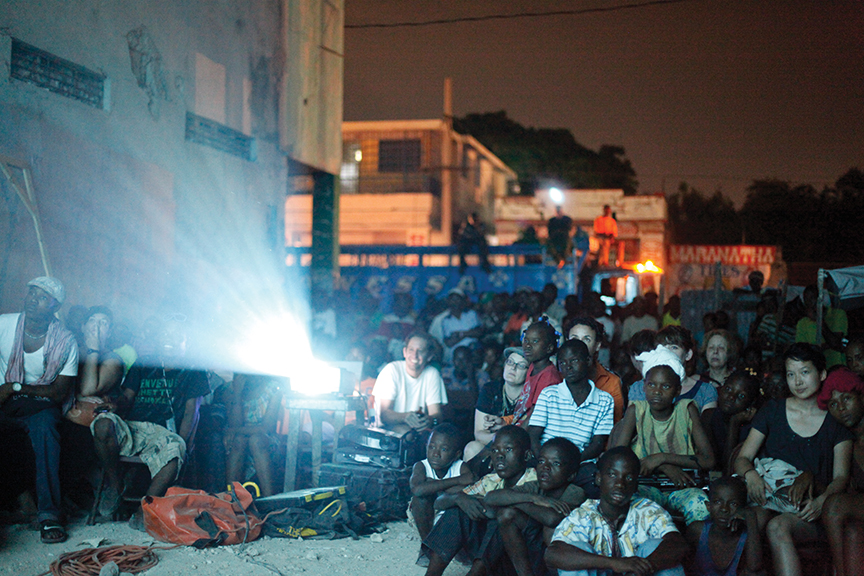
Screening of the Arcade Fire film Planet Earth at the 2nd Ghetto Biennale 2011, Port-au-Prince, Haiti
Image by Jason Metcalf
Full list of image credits here
Previous speakers in this programme include: David Teevan, creative producer, arts consultant and researcher, former director of the Clonmel Junction festival; Lewis Biggs, Chairman of the Institute for Public Art and Founding Director of the Liverpool Biennale (2000 – 2011); Shubigi Rao artist and curator of the Kochi-Muziris Biennale, India; and Fram Kitagawa, Director of the Echigo-Tsumari Art Triennale, Japan.
This research is being funded by The Arts Council of Ireland Capacity Building Fund.
Void Gallery is supported using public funding from Arts Council Northern Ireland, Arts Council National Lottery Fund, All Island Fund, Austin and Hope Pilkington Foundation, Arnold Clarke Foundation, Bank of Ireland Begin Together Arts Fund, Community Foundation Ireland, Derry City and Strabane District Council, Enkalon Foundation, National Lottery Community Fund, The Ireland Funds, Ragdoll Foundation.