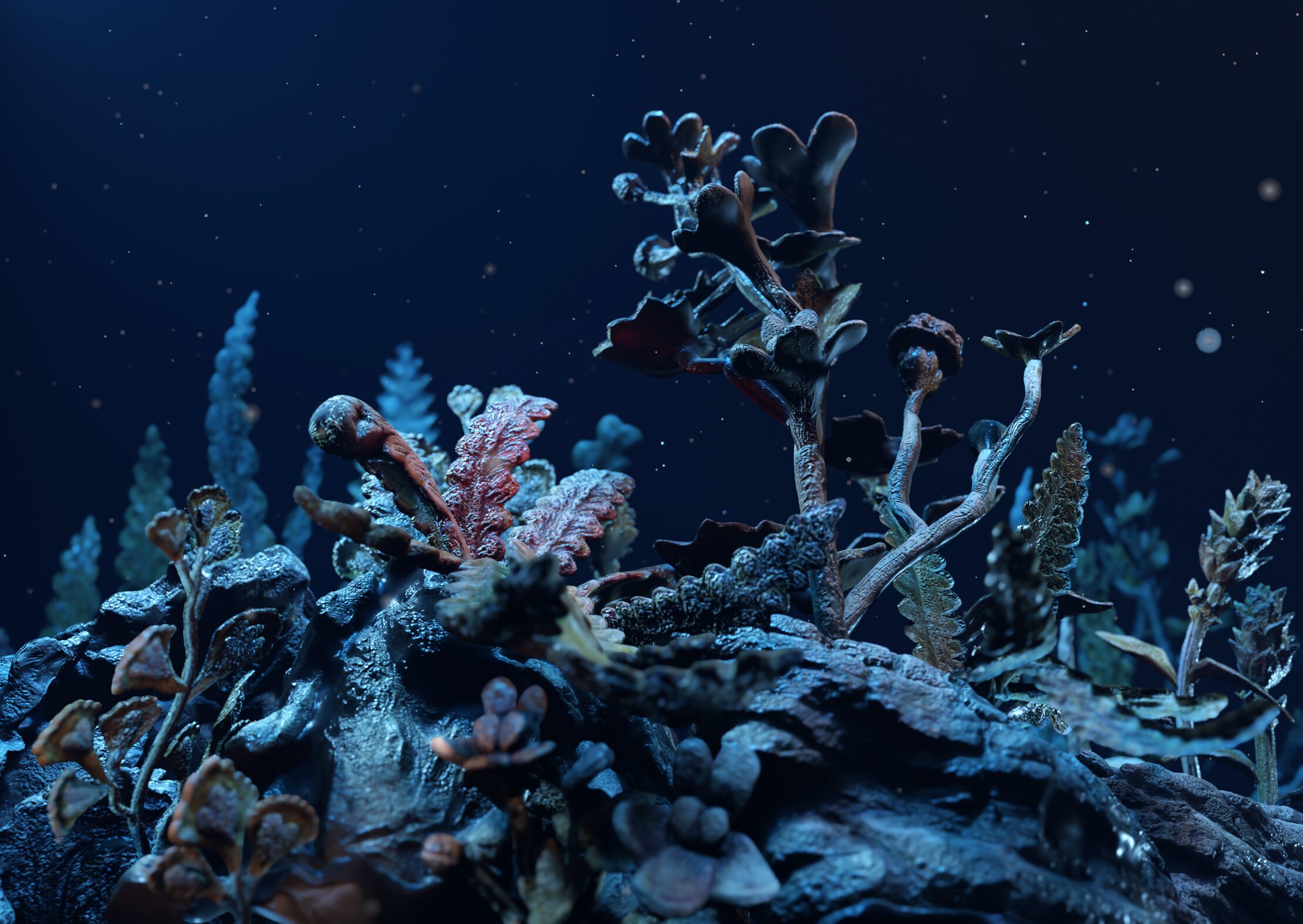
The team at Void Art Centre are excited to present our upcoming exhibition, The Breathing Wall, a solo presentation by artist Daniel Godínez Nivón which marks the artist’s first solo exhibition in the UK and North of Ireland. The exhibition opens on Saturday 26 September 2026, from 6-8pm and runs until Saturday 12 December 2026.
Daniel’s practice explores dreaming as a shared space for encountering other forms of life and sparking collective imagination. Bringing together dreams, ecological relationships and different forms of knowledge, his work explores the possibility of an ecosystem of dreams: a territory shared by humans, plants, stones and other beings. The Breathing Wall is an invitation to dream with a place and the many forms of life and memory it holds.
Developed through nearly a year and a half of artistic research, The Breathing Wall explores the material and ecological life of Derry’s historic walls. Encounters with the stone and the plants growing in its crevices, together with conversations with people dedicated to the wall’s care, including Friends of the Derry Walls and a local stonemason, shaped the research and offered ways of approaching the wall across different scales of time.
The schist used to build the wall carries the memory of an ancient seabed. Formed through immense pressure, heat and time, its mineral structure holds traces of transformations extending deep into the Earth’s history. Across its surface, Parietaria judaica, Cymbalaria muralis, Prunella vulgaris, Asplenium ruta-muraria and Asplenium ceterach grow among its joints and fissures. These plants have long histories of medicinal use associated with healing wounds, soothing inflammation and supporting blood circulation. Growing from the cracks of the wall, they form a delicate community with stone, water, microorganisms, insects and human activity.
Daniel approaches the wall through dreaming and the manual reconstruction of its material world. Stones and plants are encountered through touch, drawing, modelling and moving image. Working with these elements by hand becomes a way of studying their forms, textures and histories, and an invitation to know the wall through the body and the imagination.
Through moving image, sound, drawing, sculpture and vibration, The Breathing Wall brings geological time, vegetal life and dreaming into the same space. The exhibition approaches dreams as an ecological territory where different forms of existence can meet, and invites us to listen to the memories held within plants, stones and landscapes. Dreaming becomes a way of entering into relation with the living world and recognising ourselves within the ecosystems we share.
~~~
The Breathing Wall is supported by Arts Council Northern Ireland, Foundation Foundation and Mondriaan Fund.
Launching Saturday 4 July 2026, 6-8pm at Void Art Centre
The team at Void Art Centre invite you to the launch of ‘Animale’, a solo exhibition by British-Finnish artist and composer Hanna Tuulikki that brings together new and existing film and sound works to explore how gendered identities are shaped through entanglements between humans and the more-than-human world.
The launch will take place on Saturday 4 July 2026, from 6-8pm at Void Art Centre. Refreshments will be provided, and we welcome BYOB!
Across works Deer Dancer (2019), cloud-cuckoo-island (2016) and Seahorse (2026), Hanna uses vocal performance, costume and cinematic embodiment to reimagine masculinity as a performed and mutable condition, reframed through animal behaviour, myth and ecological relation. Moving between ritual, lament and testimony, the works trace cycles of violence, trauma, care and interdependence, positioning voice, gesture and multispecies communication as sites through which alternative, more attentive ways of being might be rehearsed.
About the artist
Hanna Tuulikki is an award-winning British-Finnish artist, composer, and performer based in Scotland. Her work explores our connection with the more-than-human world. Practising across sound art, music, visual art, and live art, she blends sonic composition with ritual forms and visual elements – including costume, choreography, and graphic scores – to tell ‘stories of re-worlding’ through immersive installation, moving image, and live performance.
At the heart of her practice, Hanna works with the voice, using singing and extended vocalisation to explore how the body communicates beyond language. Her sonic compositions weave vocal textures – both composed and improvised – with field recordings and electronics. Often site-specific, her work engages directly with place, activating natural acoustics and adopting processes of experimental translation to create hybrid ‘human-and-more-than-human’ soundscapes. Her work with choreography, costume, and visual scores expands this inquiry, examining how movement and image can embody a kinaesthetic form of listening, while her drawn notations map relationships between voices, bodies, and landscapes, deepening our sensory connection to place and ecology.
Void Art Centre are excited to announce our upcoming project, Re-turning, which launches on Saturday 25 April 2026, from 6-8pm.
With spring’s arrival, we’re thinking back to our project ‘Composting for the future’ in 2024, which publicly introduced Void’s transition to a social permaculture arts organisation, thinking through composting as a means of bringing together timelines, and recognising the many hands involved in shaping Void’s past, present and future. Since ‘Composting for the future’, we have focused on ‘turning’ the compost, creating opportunities for reflection and rest, enabling the team to look back on our work and further consider our commitment to socially engaged practice and sustainable working methods. In April 2026, we will turn the soil once more, with ‘Re-turning’ – an exhibitionary project and programme of events and training.
As well as denoting the turning of soil, Re-turning is a term from Karen Barad’s essay ‘Diffracting Diffractions: Cutting Together Apart’, which suggests that: ‘Returning denotes going back to a place or a time whereas re-turning is the act of turning over and over again – rather than going in a linear direction backwards, re-turning is like the motion of earthworms as they compost soil. They burrow through soil – opening, aerating and breathing new life into organic matter. The process never ends.’
This multifaceted project will consist of contributions from PhD student Ashab Arif Ahmad who is creating a presentation of material from Orchard Gallery’s archives held at Void Art Centre – Derry’s first contemporary arts space. In addition, we will look towards the past and future, including research and output from both previous and ongoing projects. This includes contributions from artists Daniel Godínez Nivon, Stéphane V Bottéro, Joey O’Gorman, and Barbara Steveni; researchers Matthew McAlister-Colacio, Oliver Hopkinson and Oileán Galligan, Roy Nelson and Kathryn Nelson; and our series of reading groups on institutional practice ‘Closing Circles’. Our team learning will continue with practitioner Eve Olney, co-founder of Radical Institute and events will include working with Void’s archive and an experimental Town Hall Meeting, inviting our audience to contribute ideas about Void as an organisation and its position in Derry city.
The exhibition is supported by Art Council Northern Ireland.
The team at Void Art Centre are delighted to invite you to view Barbara Steveni, I Find Myself, curated by Gareth Bell-Jones, opening on Saturday 17th January 2026, and running until 4th April 2026.
The life and work of Barbara Steveni (1928–2020), who described herself as an artist–activist, embodied an archive and pioneered a diffused art practice that resists clear definition. Invisible threads interlink the various roles she played in the contexts within which she was situated and responding to. As with other women artists of her generation she combined childrearing and managing domestic chores with the production of work, and was frequently overshadowed by her male partner’s success.
Steveni conceived the idea for Artist Placement Group (APG) in 1965, becoming its spokesperson and primary strategist. The group organised placements for artists in industry and later public institutions with the aim of improving society through the creative potential of the artist. The importance of Steveni’s role in APG was often marginalised by gender-inflected terms such as ‘honorary secretary’, her practice rarely recognised as having a value in its own right. The exhibition I Find Myself intends to redress this imbalance and encompass her life’s work, drawing together her practice and her experimentation with materials, media and strategies across a career spanning more than seventy years.
Steveni’s complex practice is simultaneously deeply personal and intimate, whilst also grand enough in conceptual scale to aim to change policy at government level. It is a dematerialised and research-based practice, married to the collection of objects and matter. Her work is unconstrained by a studio and clearly embodied in the material of her own home. Her diaries, extensive note taking and archiving reveal an artist conscious of the value of her own legacy, and yet she only later in life accepted she had an ‘art practice’ at all. Her collaborative approach was at once discrete and all–encompassing, often defining the terms of a piece after its production, drawing in bystanders and audiences as performative partners by effect.
What makes this exhibition particularly relevant today is the generosity of Steveni’s practice. She privileged discussion, and in particular conversation, as a platform to produce work. It is a practice probably best exemplified by how in later years she would welcome new relationships, through conversation over borscht at her home in Peckham, south London. The sweeping multidisciplinary discussions that took place there encompassed anything from the personal to the geopolitical, while sharing a soup that was very much a part of her past and her familial history. The proposal that an art form can exist in the world, outside of art contexts, with the artist’s role and practice framed around discursivity is an important precursor of socially engaged art practice today.
Barbara Steveni, I Find Myself is adapted from the first retrospective exhibition of Steveni’s work, originally staged at Modern Art Oxford in 2025, and has been guest-curated by Gareth Bell-Jones.
An exhibition catalogue and reader on Barbara Steveni’s work has been published by Modern Art Oxford to accompany the show and is available for purchase or to read at Void Art Centre.
Photo above: Acid Burn. Courtesy Estate of Barbara Steveni.
Photo on Homepage: APG Activity 1978-1984, by Ros and Rolf Sachsse.
The team at Void Art Centre are delighted to invite you to the launch of Pollanroe Burn, an exhibition by artist Emily McFarland, opening on Saturday 27 September 2025, from 6-8pm.
Pollanroe Burn or An Pollán Rua – the little red pool – unfolds through a series of new films and archival fragments, forming part of artist Emily McFarland’s ongoing long-term research into the shifting ecology of the Sperrin Mountains of West Tyrone, in the North of Ireland, in the shadow of proposed major industrial-scale gold extraction.
New film works, shot on 16mm and employing documentary forms, choreographed sequences, and sonic compositions, conjure speculative transformations that trace intersecting, submerged deep-time narratives: a watercourse within the Foyle Catchment, the remnants of an ancient Scots pine forest preserved in a former commercially harvested peat bog, and a singular cloudberry rhizome growing on a mountain in West Tyrone – the only recorded occurrence of the plant on the island of Ireland.
Attending to interconnected hydrological and vegetal worlds as active agents of bioregional collective memory, folk knowledge, language and resistance, the works open space for slow looking, respectful listening and imagining relations to non-human life beyond the anthropocentric frame. In dialogue with the principles of Earth Jurisprudence – the legal philosophy recognising inherent rights of ecosystems on par with human rights – the project considers land and the watercourse not only as vulnerable to extraction and erasure, but also as sites of resilience, testimony, agency, refusal and rights.
The Sperrin Mountains of West Tyrone have long been targeted by international gold mining interests and in the late 1990s, efforts to attract international mineral prospecting across the region culminated in the launch of the Tellus Project. Its stated aim was to enhance mineral exploration by collecting and disseminating regional geoscientific data, revealing significant gold mineralization across the northwest region of the North of Ireland, particularly in the Cavanacaw and Curraghinalt areas. By 2022, over a quarter of the land had been licensed under mining concessions.
In this context, the work pushes against the concept of Geontopower – the colonial ordering of both human and non-human entities, shaped by extractive and carbon-driven imaginaries. The Tellus Project exemplifies these dynamics as “the contouring and channelling of all and anything toward a European surplus”, (Povinelli, 2022) revealing how land and ecologies are measured, mapped, and valorised according to industrial and geopolitical priorities.
Against this backdrop, the project asks: How can we cultivate modes of thinking that allow both intellect and empathy to apprehend the long-standing and delicate connections between humans and their environments? And is it possible to conceive of the river and other similar non-human entitles as active, rights bearing presences?
With special thanks to Ulster Wildlife at An Creagán, the National Herbarium in Dublin and Save our Sperrins.
[photo: Pollanroe Burn (2025), video still, courtesy of the artist]
From Monday 30 September 2025 until Saturday 13 December 2025
Void Art Centre opens Tuesday to Saturday, 11am – 5pm. Please email hello@derryvoid.com for accessibility needs.
This summer at Void Art Centre we are delighted to welcome Jasmina Cibic to Void Art Centre.
The Gift Ecology, Jasmina’s first solo show in Ireland,launches on Saturday 21st June, 6-8pm and continues until 13th September 2025.
Jasmina Cibic’s The Gift Ecology continues the artist’s exploration of the anthropological concept of the gift and its inherent obligations of circulation and reciprocity, as succinctly described by Marcel Mauss in his seminal essay The Gift. At Void Art Centre, Cibic focuses on the extractivism of both nature and culture within the history of political gifting—particularly gifts that supported the construction of transnational spheres of influence through soft power strategies.
The Gift Ecology presents a new body of work spanning video installation, photography, and sculpture. These works converge in restoring agency to art objects, animals, and plants once gifted in the name of the nation. In Cibic’s installation, human and non-human actors come together as storytellers, proposing a shared politics of mutualism, collaboration, justice, and care.
A series within the exhibition, also titled The Gift Ecology, features photographs of Yugoslav government documents detailing the exchange of animals and the ritualistic functions these gifts served in constructing a new transnational political space during the Cold War—namely, the Non-Aligned Movement. This forum of developing and largely postcolonial states proposed a “third way”of governance, resisting the polarisation of the world between the United States and the Soviet Union.
Cibic overlays these archival images with white pencil, erasing the surrounding geographical landscapes and directing the viewer’s attention solely to the animals’ portraits and the diplomatic gaze their presentation once served. As many of the countries—and the multilateral alignments these animals were meant to represent—fracture and dissolve, the obligation of reciprocity tethered to these gifts dissipates. The animals, once symbols of soft power, are reframed as agents, inhabiting the ruins of colonial and ideological structures. In this context, The Gift Ecology invites us to see animals as a living archive of ongoing extractivist methods of cultural diplomacy – even within the building of the postcolonial transnational space.
Mothers (2025), a new video work, was created within the context of the archive of the Gallery of the Non-Aligned—the only institution dedicated to collecting and exhibiting artworks gifted by heads of state, ambassadors, and cultural elites of the Non-Aligned Movement. From this archive, Cibic selected only sculptures depicting female heads, busts, and figures—representations of emergent mother nations. Chosen by predominantly male government officials and created by male artists, these sculptures stand in as allegorical mother nations, representing countries whose cultural capital has consistently been obfuscated, exoticised, and/or destroyed by Western powers. In the video, these sculptures are linked through a sequence of explosions, transforming them into ciphers of ancestral urgency—a matriarchal warning system spanning territories and timelines. Illuminated like precious jewels and rotating slowly as if in a storefront display, the sculptures develop cracks that exponentially accumulate until the objects ultimately disintegrate into dust and debris, only to re-emerge as a new sculptural configuration. These too are female forms, mothers shaped by different cultural and political contexts. This cyclical eternal transformation underlines the necessity of the enduring process of resilience-building, where symbolic collapse becomes the ground for reinvention.
The accompanying soundscape merges ASMR-inspired textures—highlighting the contemporary voyeuristic pleasures derived from destruction—with a female narrator voicing words of resistance and strategies for survival, drawn from archival debates on cultural sovereignty and self-determination.
The final component of the exhibition is a collaborative project with United Nations human rights advocates. The UN, as the symbolic parent of the Non-Aligned Movement, was the setting where the term “Non-Alignment” was first introduced by India and Yugoslavia in 1950 in relation to the Korean War. For this work, Cibic invited members of the UN Human Rights Treaty Bodies to donate their tears, which she then photographed under a microscope. Resembling planetary terrains, these images are transferred onto brass plates. At first glance resembling celestial bodies, the works confront viewers with the fragile terrain of human rights advocacy within the erosion of international law. They serve as a speculative invitation to imagine a more just world—even as a parallel universe built from the potential futures of the past.
The exhibition culminates in a suspended bronze globe featuring fictional islands, continents, and waterways—all derived from the microscopic tear photographs. Cast in bronze—a material historically bound to patriarchal symbols of power—the rotating globe suggests a reversal of the extractivist gaze employed by hegemonic systems in the production of patriarchial spectacle. The sculpture becomes an illusionist device, hinting at new planetary imaginaries born from care, resilience, and restitution.
Jasmina Cibic’s exhibition at Void Art Centre addresses both historical and contemporary contexts of self-determination and cultural emancipation. Through its layered installations, the exhibition reflects on the extractivism of nature and culture as tools of nation-building. It interrogates our present-day fascination with ruins, the exoticisation of indigeneity in post-collapse cultural movements, and asks: What role can art and culture play within dissolved systems of solidarity – and care and how might they help us imagine new forms of agency?
Void Art Centre opens Tuesday to Saturday, 11am – 5pm.
Please email hello@derryvoid.com for accessibility needs.
photo: Mother (2025), video still, courtesy of the artist
Launching on Saturday 26 April 2025, 6-8pm at Void Art Centre, until Saturday 7 June 2025.
We’re excited to invite you to The Wishing Forest, a project initiated by Stéphane V. Bottéro in collaboration with Boris Raux, Maud Louise-Marie, George McLaughlin and Prehen Wood, Rachel Duffy and the Playtrail, Roy and Kathryn Nelson at Killymuck, Philip Allen and Ruth McCartney.
The Wishing Forest is a long-term socio-ecological art project which aims to instigate a collective rethinking of how local institutions can collaborate on life-nurturing commitments that benefit more-than-human communities.
Titled after a poem by Seamus Heaney, The Wishing Forest seeks to repurpose modern institutional tools, such as the tradition of artwork acquisitions by public art collections, in order to restore biodiverse woodlands. In doing so, the project thinks through ways in which forestry can be redefined as an artistic process in its own right.
The Wishing Forest, in its long-term nature, has comprised a period of research with local researchers, ecologists and activists. During this process, we learnt about small woodlands being grown in the north of Ireland, and the multiple ways in which the public are invited into these sites which shelter biodiverse habitats whilst being spaces used for creative, educational and well-being purposes.
This iteration of The Wishing Forest at Void operates as a public launch of the project, acting as a gathering space for actors, a poetic and speculative reflection and a platform for sharing knowledge, process and research, highlighting the many hands involved in this work.
Stéphane’s solo exhibition The Wishing Forest is supported by Fluxus and Arts Council Northern Ireland.
Homepage image by Shakira Nelis, Void Art Centre.
Image above by Sinéad Feeney, Void Art Centre.
As the spring sun made its appearance in Ireland, the team at Void joined artist Stéphane V Bottéro for a week researching local forests, learning about those advocating for our local green spaces and ancient woodlands. Throughout the week we visited small, young forests, ancient woodlands and sites that encourage inter-generational use of our surrounding environment. We learnt about the importance of flora and hedgerows in woodland floors, activists engaged in advocacy for our local woodland and the developmental pressure facing these sites, permaculture tools for more sustainable living and economies, the multitude of ways we can develop learning and play within forest sites, and folklore and writing associated with rural, Irish living. We also heard from producer and researcher Chris Fremantle during a thought-provoking talk about artistic projects in relation to forests.
With thanks to all those who shared so generously with us, including those who led field trips – Kathryn and Roy Nelson, Rachel Duffy, George McLaughlin and Phillip Allen. We’re excited to continue the conversations on the journey ahead.
This research week forms part of the project The Wishing Forest, initiated by Stéphane V Bottéro. The project, which is intended to be long term, is just at it’s starting point, with research from field trips and meetings forming part of an initial presentation at Void Art Centre.
This presentation opens on Saturday 26 April 2025, from 6-8pm.
Main image: George McLaughlin overlooking the fields at Prehen Woods. Photo by Sinéad Feeney, Void.
Image: Void Art Centre team with Stéphane, Kathryn and Roy Nelson in Killymuck. Photo by Shakira Nelis, Void.
It is winter at Void Art Centre and time to reflect. This year we are grateful to inhabit the coldest season with a project that grows ideas we have been nurturing throughout the previous seasons.
We are happy to do so with a long-term project by Deirdre O’Mahony; an artist with whom we not only share an interest for food and farming but to whom we also feel very connected because of her slow and in depth approach to research and art practice.
FARMWORK presents a selection of Deirdre O’Mahony’s artworks made over the past ten years, reflecting on her interest in the politics of landscape, rural sustainability and food security, challenging mainstream narratives around agricultural matters and policy.
In this project three distinct bodies of work expand on questions prompted by the artist’s extended research into the history of agricultural development.
Trial + Error reflects upon the efforts of one man, John Silke, to build up the seed potato industry in Donegal.
FARM is a photographic and text installation of small farms in Ireland, UK and USA, including a new selection of image/texts from Northern Irish farmers.
At the heart of the exhibition The Quickening, a sound and moving image artwork, reflects on the relationship between farming, food production, and the social and economic impact of agricultural policies on soil, biodiversity, and climate change.
Thanks to the Arts Council of Northern Ireland’s support, Deirdre visited us in November for a field trip here in the North West. She met with some generous farmers and carried out more research and production locally.
We are very excited to witness the final outcome of this fantastic journey together.
The Quickening was commissioned by The Douglas Hyde Gallery, Dublin and supported by The Arts Council of Ireland/An Chomhairle Ealaíon.
Deirdre O’Mahony has an impressive 30 year track record in making work across sculpture, painting, installation and participatory projects. At the centre of this work is her interest in the politics of landscape, rural/urban relationships, rural sustainability and food security. She has investigated the political ecology of rural places through public engagement, exhibitions, critical writing, and cultural production. From setting up community spaces amongst a charged local conflict to her large-scale paintings produced by tracing the shadows of boulders on Mullaghmore Mountain in the Burren National Park, she deftly consider the role of art in bringing together diverse communities, alternate forms of knowledge, embracing art as a critical space to help us see things differently.
Acknowledgements
Front image:
Deirdre O’Mahony, The Quickening. Production still (2023). Photography by Tom Flanagan.
Void Art Centre is kindly supported by the Arts Council of Northern Ireland, Derry City and Strabane District Council, Future Screens NI, Garfield Weston Foundation, Halifax Foundation for Northern Ireland, the Henry Moore Foundation, Northbound Brewery and Ulster University.
The team at Void Art Centre are delighted to welcome Mikhail Karikis.
What artistic responses can we invent in the face of climate collapse to inspire alternative visions to the dominant apocalyptic climate discourse? How can we collectively tune into the sonorities of socio-political change and ecology? Acoustics of Resistance is a multi-media project comprising of works that collectively tune into the sonorities of socio-political change and ecology. It rejoices in the transformative and healing powers of listening and sound-making while declaring that changing the course of climate change is in our hands and lies on humans learning the language of nature.
Surging Seas and The Weather Orchestra are two installations that approach the theme of climate change from the perspectives of scientific data, collective and individual emotional response, speculative thinking and sounding. They are an ode to the elements, expressing our deep relationship and entanglement with the weather and celebrating our connection to the atmosphere and the earth. Surging Seas comprises video, a textile work references thermal maps and a display of placards with futurological flood maps. The Weather Orchestra was created with diverse performers from different climes and takes the form of multi-channel video installation with surround sound. The installation transforms the gallery space into an indoor weather system generated through sound vibration and singing. Three projections feature Iberian female musicians performing on instruments and analogue noise machines designed to imitate the sounds of natural phenomena. From the old wind machine to the ancient Latin American ceremonial rain stick, ocean drums, aqua-phones and thunder sheets generate sounds that allude to the forces and magnificence of nature. In the middle of this soundscape and swept up by the noise, human voices burst with folk songs from different cultures as a reservoir of knowledge and connection with nature, expressing joy, respect, fear and wonder toward all elements surrounding us. In his mourning song, a Syrian refugee asks the rain to become ‘mute’ in his dedication to friends and family he lost at sea on their way to Greece. A Danish folk singer recalls an ancient nordic song asking the sun to come and warm the seeds to sprout. A Madeiran islander begs the fog to clear because it threatens his life. A Portuguese singer sings an ancient pagan-christian prayer to Santa Barbara requesting her to calm the tempest at sea.
Biography
Mikhail Karikis is a Greek-British artist working with moving image, sound, performance and other media. Through collaborations with individuals and/or communities located beyond the circles of contemporary art, and in recent years with children, refugees, support workers and people with disabilities, he develops socially embedded projects that prompt an activist imaginary and rouse the potential to invent hopeful and sustainable futures. Focusing on listening as an artistic methodology, and the voice as a socio-political agent he centers on themes of environmental and social justice. His projects highlight alternative modes of action and solidarity, while nurturing critical attention, dignity and care.
Karikis exhibits internationally. In his most recent work for the stage, ‘Universe of Solutions’, he was artistic director for UNESCO’s Creative Cities Network inaugural cultural event for which he created a performance with 150 young people. Group exhibitions include 54th Venice Biennale, (2011), IT; Manifesta 9, Ghenk, (2012); 19th Biennale of Sydney, (2014); Kochi-Muziris Biennale, IN, (2016); MediaCity Seoul, KR (2015); British Art Show 8 (2016-7); 2nd Riga International Biennale of Contemporary Art, LV (2020), 2nd Saitama Triennale (2024), JP and others.
Solo presentations include Songs for the Storm to Come, HOME Gallery, Manchester, UK; Voices, Communities, Ecologies, Cukrarna Centre for Contemporary Art, Ljubljana, SO (2024); Because We Are Together (2023), National Museum of Contemporary Art, Athens GR; Ferocious Love, Tate Liverpool (2020); For Many Voices, Middlesbrough Institute of Modern Art (MIMA), UK (2019-20); Children of Unquiet, TATE St Ives, UK (2019-20); I Hear You, De la Warr Pavilion, UK (2019-20); Mikhail Karikis, MORI Art Museum, Tokyo, JP (2019); No Ordinary Protest, Whitechapel Gallery, London, UK (2018); Ain’t Got No Fear, Turku Art Museum, FI (2018); The Chalk Factory, Aarhus 2017 European Capital of Culture, DK (2017) and Love Is the Institution of Revolution, Casino Luxembourg Forum d’art Contemporain, LU (2017).
Karikis’s creative endeavours include music performances at Royal Opera House Covent Garden and Barbican Theatre, and musical collaborations with Björk, DJ Spooky and the Belgian record label Sub Rosa.
Forthcoming exhibition in 2025 include a career survey show at Kunstmuseum St Gallen in Switzerland and a solo exhibition at The Showroom, London.
Press
Listen to Mikhail speaking with Luke Clancy on RTE Lyric FM’s Culture File here.
Read the interview between Mikhail and Derry Journal reporter Kevin Mullan here.
Void Art Centre is kindly supported by the Arts Council of Northern Ireland, Derry City and Strabane District Council, Fluxus Art Projects, Foundation Foundation, Future Screens NI, Garfield Weston Foundation, Halifax Foundation for Northern Ireland, the Henry Moore Foundation, Northbound Brewery and Ulster University.
Image: Mikhail Karikis, The Weather Orchestra, video still, 2022
Void Art Centre is delighted to announce Nyctalopia, an exhibition by Adrián Balseca.
Adrián Balseca’s Nyctalopia, his debut solo exhibition in Northern Ireland, is a commissioned research project at Void Art Centre in Derry. This two-part multimedia installation critically examines the impacts of car culture by offering alternative perspectives on the ongoing ecological crisis. “Nyctalopia,” or “night blindness”, symbolises a collective condition in post-neoliberal economies, characterized by an inability to clearly perceive the current environmental crisis.
The exhibition showcases a series of modified optical devices that reveal an uncanny visual perception of the present. By juxtaposing ancient obsidian glass with iconic mid-20th-century car wing mirrors —both found in Northern Ireland— Balseca creates dark reflective tools that enable the public to revisit geological and material history, serving as a powerful reminder of the silent violence afflicting our environment. These optical devices challenge our visual perception, transforming common views into darker reflections on human mobility based on fossil fuels and carbon-based industries, which have displaced collective mobility systems in Northern Ireland and reshaped the land.
This installation underscores the necessity for humanity to reconsider imposed narratives of infinite economic growth and to address fundamental philosophical questions about coexistence and abandonment. The concepts of “distance” and “time” in car wing mirrors are depicted as defence mechanisms that shield humanity from the immediacy and precariousness of global pollution and degradation. How has automobile culture shaped our environment? Employing a diverse array of mediums—including film, sound, archives, and sculpture—the project merges cultural artefacts, from photographic archives to automobile accessories, to embody a somber reflection on the power of these economic forces.
“Ecological reality requires an awareness that at first has the characteristics of tragic melancholy and negativity, concerning inextricable coexistence with a host of entities that surround and penetrate us, but which evolves paradoxically into an anarchic, comedic sense of coexistence (Morton, 2016:160). By confronting the “ecological nyctalopia”, we are driven to instigate transformative cultural shifts and rediscover the “archaeologies of the future”.
Composting for the future: an exhibition and long-term period of research and training that reflects on ways of working within Void, past and present.
Launching Saturday 23 March 2024, 6-8pm
Void Art Centre is excited to present Composting for the future, a twofold exhibitionary project taking place across the organisation. Composting for the future marks Void Art Centre’s commitment to a living practice of Social Permaculture, a group of principles that look to models of co-existence and co-creation in permaculture and our more-than-human world. Our organisational structure will be re-imagined, becoming based on collaborative methods of working and sustainable use of logical resources such as project production. Composting for the future represents the initial starting point for this transformation.
‘To look to the future, it’s important to celebrate the past.’
With 2024 marking twenty years since Void Art Centre was constituted, we wish to celebrate the organisation across its many iterations. To do so, we have invited practitioners who have contributed to Void in different capacities to work with us: Paola Bernardelli, who cared for and documented Void’s archive; Gregory McCartney, who was a member of Void’s Curatorial Committee; and Damien Duffy, also a member of the Curatorial Committee, who delivered the education programme Void Art School. Through sharing their own relationships to Void Art Centre, each will unearth and make public stories and memories to be presented in a collectively designed timeline that details Void’s past twenty years, and the corresponding historical context. The timeline has also been co-edited by invited practitioners including Michael Bradley; Eibhlín Morrison; Catherine Ellis; Megan Doherty; and Audrey Blue. Each editor has selected a work or project from Void’s history, including ephemera from the planning and installation of past exhibitions, which will form part of the collectively built timeline.
Alongside this, the team at Void Art Centre have delved into the organisation’s archive, selecting previous commissions and new material to bring to the public again, including Tax Return (2018), a work by Keef Winter and 4 Studi sull’Increspatura del Mare (2021) by Invernomuto, a fragment of Alan Phelan’s collectively created public sculpture RGB Hyacinth and a piece from our commission with Forerunner, Office of the Rest.
We are also inviting the public to contribute to this collective timeline, with a history-making station forming part of the exhibition. At this station, the public will be able to research and select more archival material to be added to the timeline. This timeline references the art collective Chto Delat’s project Times, Lines, 1989s at CCA Glasgow (2019) and Group Material’s AIDs Timeline in 1989, which invited the public to co-design a collective timeline, building alternative historical narratives.
In tandem with this, we will introduce the future of Void Art Centre, as we become an organisation that upholds the three key pillars of Social Permaculture – Earth care, People care, Fair share. Learning from permaculture ethics and principles, we will re-configure our organisational structure, embedding the sustainable use of local resources within our daily working practices and approaches to programming.
Since February 2024, Void Art Centre has been hosting a Social Permaculture hub which acted as a training ground for Social Permaculture activities, including training by Dorian Braun, Alfred Decker and Stéphane Verlet Bottéro. We will present this process in the form of notes and posters created by Alfred Decker, and Notes towards a Permacircular Museum, a long-term artistic project by Stéphane Verlet Bottéro that has been brought to the context of Derry, and created in collaboration with Echo Echo and the team at Void Art Centre.
Karla Sánchez, co-founder of Blackbird Cultur-Lab, will share a collection of publications that expand on farming and agriculture from historical, political-economy, and regenerative-agriculture perspectives, held in a temporary library resource created for Composting for the future.
Concurrent to the exhibition and hub, a public programme will accompany the project, bringing Void’s history and future working practices to events, workshops and reading groups.
Composting for the future is supported by Arts Council Northern Ireland, Fluxus and Halifax Foundation, and is sponsored by Northbound Brewery.
Image: Stéphane Verlet Bottéro, Exhibition-making, education, and care in times of ecological crisis, ZKM Museum, 2021